

How to improve Cervical Cancer screening in resource-limited settings? The results of the PAVE Study
These countries account for nearly 90% of deaths related to this disease, which remains one of the leading causes of cancer-related mortality among women. Yet cervical cancer is largely preventable. Vaccination against human papillomavirus (HPV), which causes almost all cases of cervical cancer, can prevent the infection and screening, can detect and treat lesions before they develop into cancer. However, in many settings, these tools remain difficult to access.
The study involved more than 50,000 women across nine countries. Its findings represent an important step forward in the search for prevention strategies adapted to resource-limited settings. The MSF Foundation, alongside MSF and Epicentre, contributed to this work, notably by supporting the fieldwork in Malawi.
Innovating for better screening: The MSF Foundation's commitment
In many countries, a lack of specialized professionals, long travel distances, the cost of tests, and the limited availability of equipment make access to screening and its large-scale implementation challenging.
It is against this backdrop that the MSF Foundation launched the AI4CC (Artificial Intelligence for Cervical Cancer) project in 2020, a research programme dedicated to evaluating innovative technologies, including AI, to improve the detection of cervical precancer in the contexts where MSF operates.
Our goal was to screen more women, earlier, and more reliably. We quickly realized that AI alone was not enough. AI4CC therefore evolved into a broader approach, based on the use of complementary tools. And that is precisely what PAVE offered

In 2022, the MSF Foundation, MSF and Epicentre joined the international PAVE consortium, coordinated by the National Cancer Institute (United States). The objective was to evaluate a new screening strategy that could be implemented in health systems with limited human and financial resources.

Diego Menjibar
A two-step strategy
The PAVE study evaluated a strategy that combines two complementary innovations to identify women at high risk of precancerous lesions.
- First, women provide a self-collected vaginal sample. The sample is then analysed using a simplified HPV test.This test detects the presence of HPV and simultaneously identifies the specific strain (genotype) of virus. Because different strains have different likelihood of causing a cancer, this information allows to distinguish women who need to be prioritized for further examination.
- Women with an HPV positive result then undergo a visual examination using a digital colposcope equipped with AI. The device captures images of the cervix, which the algorithm analyses and combines with HPV genotyping results to estimate the likelihood of precancerous lesions. It therefore provides decision support for healthcare providers. When necessary, the same device is also used for thermal ablation treatment.
Diego Menjibar
An international study, including implementation in Malawi
Between 2022 and 2025, more than 50,000 women participated in the study across nine countries.
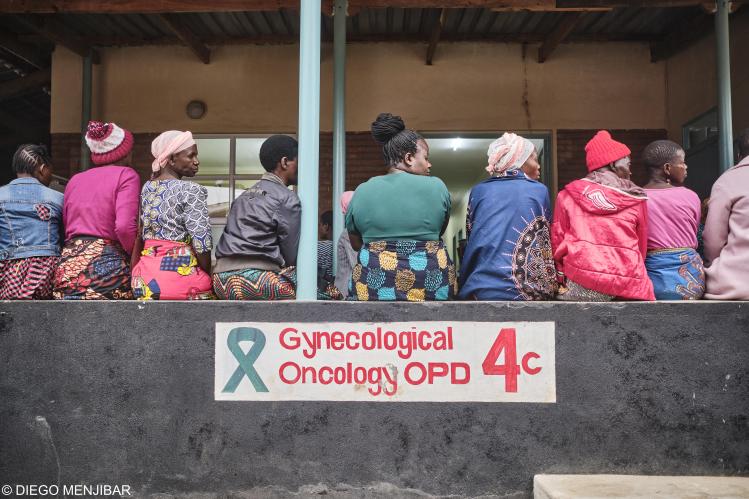
In Malawi, where MSF has been running a cervical cancer prevention and care programme since 2018, the MSF Foundation supported coordination and implementation of the PAVE study.
A total of 6,100 women were enrolled in the first phase of the study, focused on the evaluation of the strategy and validation of the AI, and more than 1,300 in the second phase, which tested the use of the algorithm in the field.
What four years of research have taught us
The results of PAVE, published in The Lancet Obstetrics, Gynaecology & Women’s Health, provide evidence on the performance of this strategy in resource-limited settings and open the way to new screening approaches.
Self-sampling expands access to HPV screening
The field experience demonstrates the feasibility of self-collection for HPV testing. This approach can facilitate access to screening, particularly for women who live far from facilities offering specialized care. Self-sampling also offers greater privacy and reduces the discomfort, pain or anxiety often associated with speculum examinations. It also contributes to a more efficient use of healthcare resources by ensuring that additional examinations are reserved for women with a positive HPV result while those with a negative HPV result can be reassured.
Genotyping can identify women at risk
The presence of HPV does not mean that a woman will develop cancer. Most HPV infections will resolve spontaneously. When not, genotyping helps distinguish infections associated with a higher likelihood precancerous lesion and prioritize them for further examination. This is particularly important in settings where medical resources are limited and where care needs to focus on patients most at need.
HPV35: a particularly common genotype in Africa
A substudy focusing on HPV35, which is particularly prevalent in Sub-Saharan African countries, has provided a better understanding of the prevalence of this genotype and its carcinogenic potential. These data may help inform advocacy efforts aimed at adapting prevention strategies, as this genotype is not covered by currently available HPV vaccines.
Artificial Intelligence as a clinical decision support tool
PAVE analyses show good agreement between the estimates generated by the AI algorithm and biopsy-confirmed diagnoses. These findings highlight the value of combining AI-assisted visual assessment with HPV genotyping to better stratify the risk of precancerous lesions. AI does not aim to replace the diagnosis made by healthcare professionals, but it can serve as a clinical decision support tool, particularly in settings where specialists are scarce.
We have shown that this strategy combining HPV testing and AI can be implemented in real-world healthcare settings, including rural areas. It confirms that HPV screening is feasible in these settings and that AI enables more refined risk stratification, facilitating the identification of women who require prioritized care. The data collected are essential for informing discussions on the implementation of screening strategies in resource-constrained settings

From research to operational implementation
In 2026, the lessons learned from the PAVE study are being presented at several international conferences and congresses. This phase of scientific dissemination aims to share the study's findings with the international scientific community and stakeholders involved in cervical cancer prevention.
Alongside this scientific dissemination, some of PAVE’s findings are already being put into practice. In Southern Malawi, HPV screening, including self-sampling and HPV testing with genotyping, is now integrated into the routine activities of the MSF programme and included in its operational budgets. This marks an important step towards making screening more accurate and more accessible for women.
At the same time, the artificial intelligence remains under research, with opportunities to learn more from the data and to further improve the algorithm.
The publication of the PAVE results is therefore not an endpoint, but a step in a longer process. Scientific and clinical demonstration that a strategy works is not enough to ensure its success in the field. It must still be put into practice and adapted to operational realities: ensuring that the necessary equipment is functional, that teams are trained to use these new tools, that tests and examinations can be performed within reasonable timeframes, and that they remain financially accessible. To ensure these practices are sustainable, it is also necessary to assess whether they are accepted by both patients and healthcare providers, and whether the political commitment and financial resources required for their long-term implementation are in place.
This is at the heart of the MSF Foundation's work: bridging the gap between scientific evidence and the reality of healthcare delivery, transforming a promising innovation into a practice that works in real-world conditions, sustainably and at scale. In Malawi, this work has already begun. It is this ability to support innovations through to their concrete adoption by healthcare teams that ultimately determines their true impact.

Diego Menjibar