Burn Rehabilitation in Syria: preserving function and supporting recovery
As part of its specialized rehabilitation development program, the MSF Foundation supports Médecins Sans Frontières teams in the management of burns— a complex, long-term form of care requiring specialized expertise.
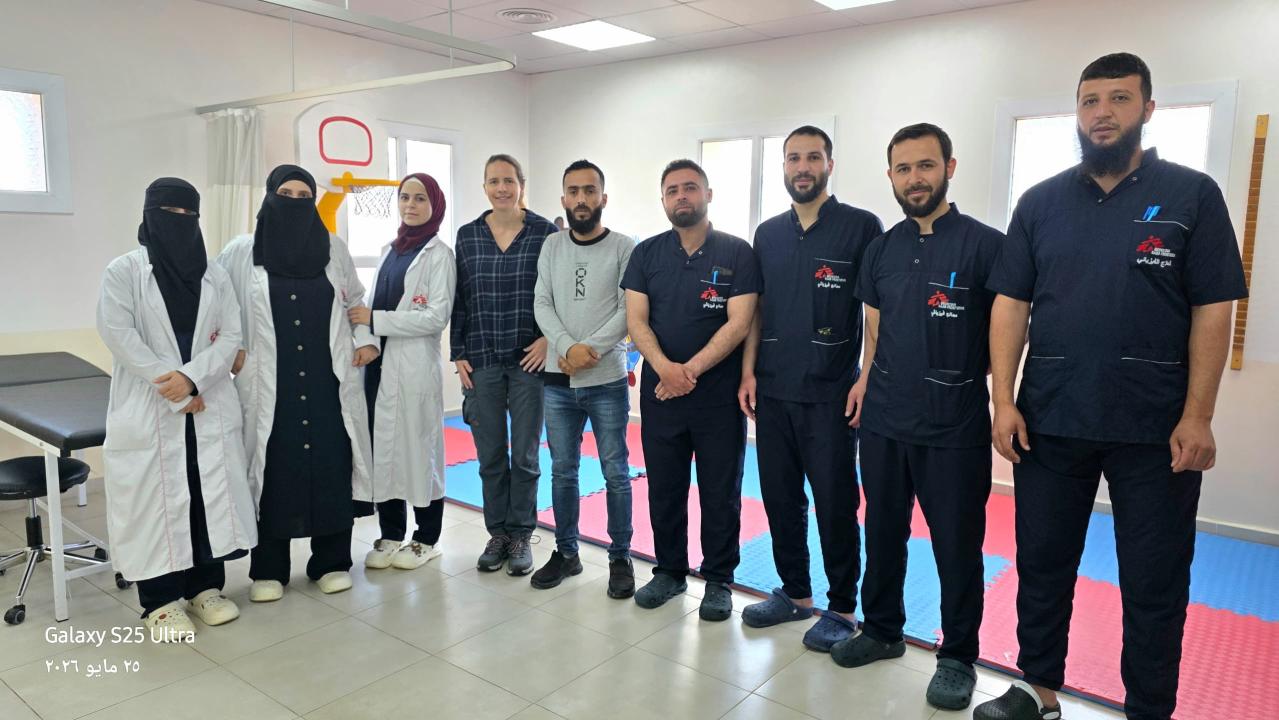
Last May, Violette, a physiotherapist and clinical burn specialist for the MSF Foundation, traveled to the MSF hospital in Atmeh, in northwest Syria, to support the rehabilitation team. She reflects on the challenges of this type of care and the follow-up of a young patient, Khalid.
A major issue
Why is burn care a particularly important issue in this context?
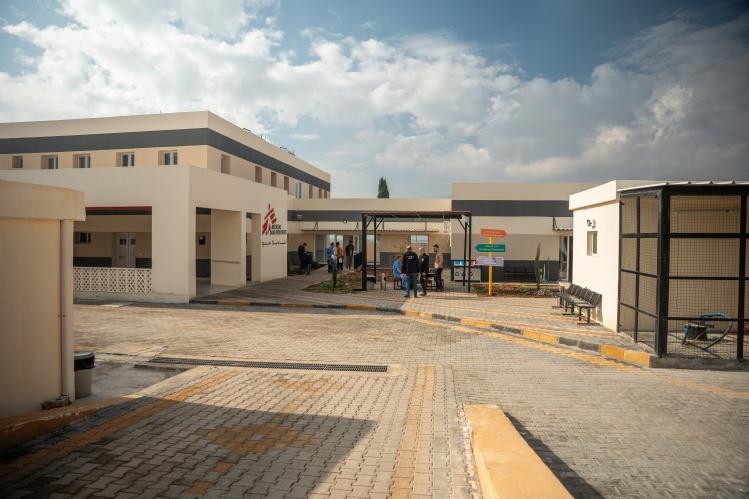
Burn care is inherently complex, as it requires a multidisciplinary approach: surgery, medical care, psychological support, and rehabilitation. In a context such as northwest Syria, where resources and access to specialized care remain limited, the MSF hospital in Atmeh plays a key role by providing comprehensive and continuous care for burn patients.
This issue is all the more critical that the majority of patients are children, often victims of burns linked to domestic accidents.
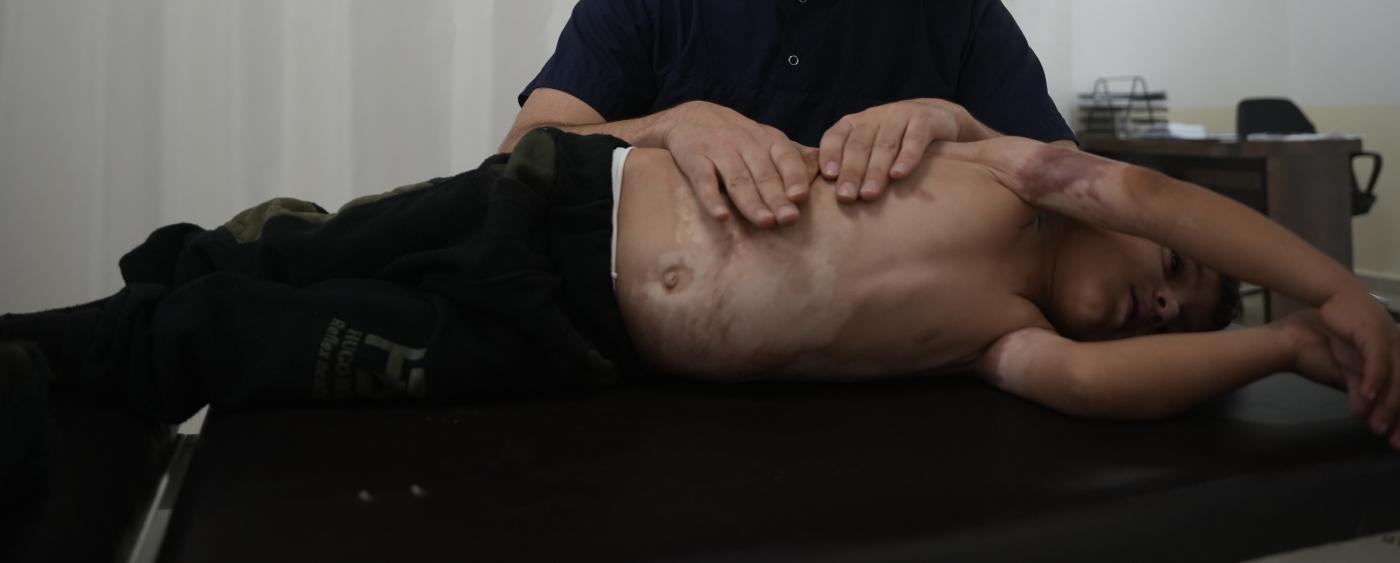
Rehabilitation is a full part of this care. Its aim is to prevent contractures, preserve mobility, relieve pain, and support the evolution of scars, sometimes over several years.
AbdelRahman Sadeq/MSF
The MSF Foundation’s work in Atmeh
What is the role of the MSF Foundation with rehabilitation teams?
We support teams in developing specialized skills. Concretely, this involves remote work and regular field visits: training in burn-specific techniques, discussions around complex cases, assistance with organizing activities and coordinating them with other specialties, and identifying and providing equipment suited to field constraints.
Over the past year, the Foundation has also been developing the 3D program (click here to watch the video), which makes it possible to produce high-quality compression devices, useful in treating burn scars on the face or neck.
The objective is to strengthen the autonomy of teams and enable them to integrate approaches that are not always available in these contexts.
How is rehabilitation organized at the Atmeh hospital?
The team consists of one supervisor and seven physiotherapists. They work across different stages of the care pathway —in surgery, inpatient care, and outpatient care—rotating among team members.
Sessions are adapted to each patient. They rely on different techniques, such as massage, stretching, or the use of equipment to position patients appropriately or work on mobility. Care is adjusted according to the affected areas, the evolution of scars, and the patient’s tolerance.
Khalyd’s story
You notably followed Khalid’s case. Can you tell us more?
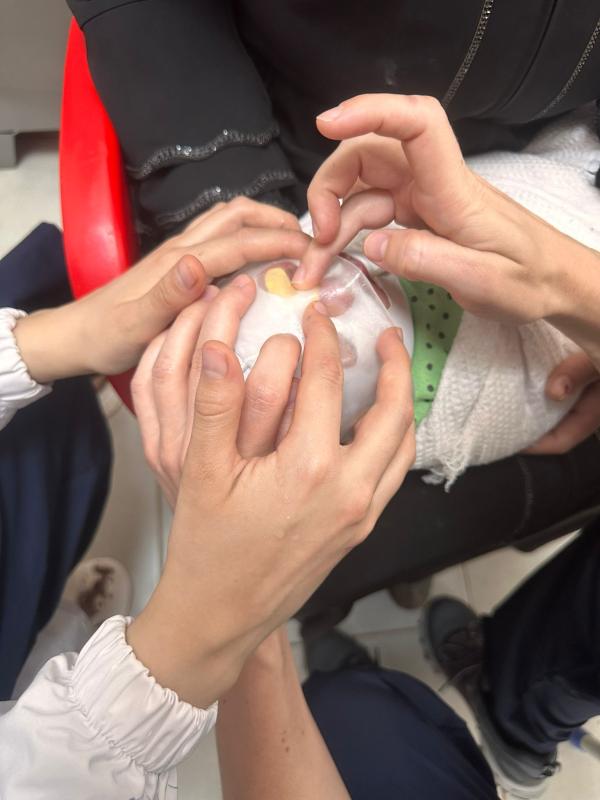
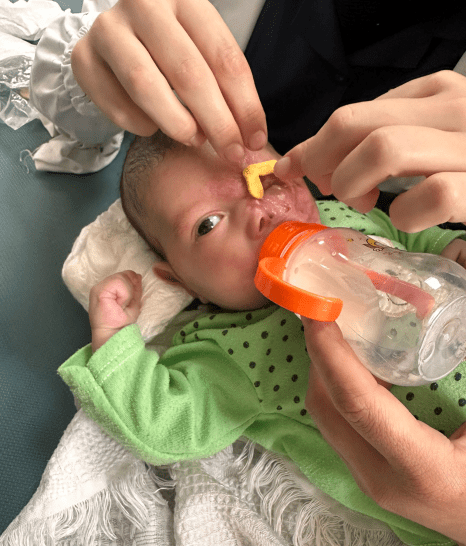
Khalid is a three-month-old infant, severely burned on the face in his first weeks of life, with injuries across the entire left side of his face. Initially treated in Turkey, he did not receive rehabilitation before being admitted to the Atmeh hospital several weeks after the accident.
Upon arrival, scar-related complications severely limited certain functions: he could barely open his left eye or left nostril and also had difficulty opening his mouth, and therefore feeding. Without appropriate care, this type of limitation can quickly worsen and lead to long-term functional loss.
Physiotherapists follow him with three sessions per week, including massage, stretching, and occasional use of a splint to work on mouth opening. After one month, progress has been gradual but noticeable: eye opening is now possible, and feeding has improved.
What are the specific aspects of care for an infant?
In an infant, rehabilitation not only treats the consequences of burns but also supports the child’s development. When a function is impaired very early on, it sometimes needs to be built as much as recovered.
In Khalid’s case, the scar almost completely prevented the opening of his left eye from the first weeks of life. He barely used it and kept it closed, both due to tension related to the scar and lack of habit. Rehabilitation therefore aims to restore this function, but also to help him gradually learn to use it.
patient care
What is the role of families in this care?
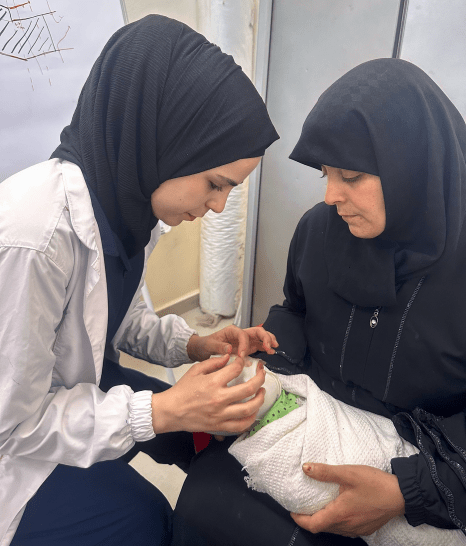
Their role is essential. Physiotherapy sessions alone are not enough: adherence to protocols for wearing splints or compression devices, and the regularity of mobilization, are decisive—even over short durations, a few minutes repeated several times a day.
The team therefore trains parents in massage and stretching techniques so they can replicate them at home. This ensures continuity of care between sessions and improves outcomes.
It is also a key element in building a relationship of trust with families.
A custom mask was made for Khalid. What is its purpose?
A thermoplastic facial mask was made to apply targeted pressure to certain areas of the face and limit deformities. This material can be hand-molded directly onto the patient’s face, allowing it to adapt to more hollow or irregular areas.
In Khalid’s case, the use of this type of device was preferred due to his age: the bones of his skull are not yet very strong, and he is still growing, which requires many precautions.
The implementation of these techniques was only possible thanks to the involvement of his family, who carefully follow recommendations and strictly adhere to follow-up appointments. This collaboration is essential to ensure the effectiveness and safety of the treatment.
What are the prospects for the continuation of his care?
A surgical intervention is currently being considered, particularly to improve eye function. After this stage, various options may then be considered to continue scar management.
The MSF Foundation is also studying the possibility of equipping Khalid with a device from the 3D program. These solutions, designed using advanced modeling techniques, are usually reserved for older patients. In infants, facial growth requires very frequent mask adjustments. Including such a young patient would be a first within this program.
What do you take away from this mission?
What particularly struck me is the commitment and level of the local teams, who manage to care for complex cases with limited resources.
This mission allowed me to concretely support the Atmeh team and shows that it is possible to develop specialized approaches and high-quality care, even in humanitarian contexts often perceived as limited to emergency care.
Beyond immediate care, the challenge is not only to save lives but also to preserve function, autonomy, and patients’ quality of life in the long term. It is within this perspective that our support operates.